On the way to becoming a hydrogen hub
Egypt has a goal in mind: by 2040, the country on the Red Sea wants to supply up to eight per cent of the global market for green hydrogen and thus establish itself as an international hydrogen hub. The course has already been set with the national strategy for green hydrogen. The task now is to drive forward its implementation. And to answer the most pressing questions about the hydrogen economy.
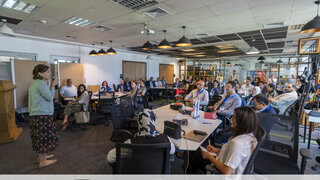
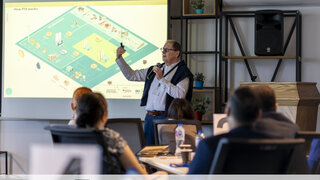
This brought together political representatives from Egypt and Germany in Cairo in September 2025. There, the energy partners took the opportunity to develop concrete approaches for a successful hydrogen economy and production in Egypt.
The focus was on:
How can hydrogen projects be financed efficiently?
What strategies ensure balanced risk management?
And how can infrastructure needs and government requirements be harmonised in the best possible way in order to strengthen investment and promote innovation?

Where sun and wind shape the future
Some of Egypt's electricity already comes from renewable sources. From wind farms on the Red Sea, such as theRed Sea Wind Energy Park, to the Benban solar park, which is one of the world's largest solar parks. Such large-scale projects are already feeding 12 per cent green electricity into the Egyptian population's grids.
This share is set to increase significantly by 2030. To 42 per cent. And Egypt has the ideal conditions for this: plenty of sunshine, little rainfall and above-average winds along the Red Sea, in the Western Desert and in the Gulf of Suez. These very favourable climatic conditions make Egypt an international hub for renewable energies.
However, the production of wind and solar energy is not only valuable for the local population. It also creates the basis for green hydrogen.
Egypt's hydrogen future
In order for Egypt to realise its potential in the global hydrogen market, financing, infrastructure and legislation must be interlinked. This requires: secure financing, government investment in infrastructure, targeted funding programmes and a reliable local legal framework. With it, planning security that enables investors to make long-term decisions can be ensured.
Moreover, cooperation between business and politics is just as crucial. Together, they can develop financing models that will sustainably advance the hydrogen market.
This is precisely where the hydrogen dialogue platform of the Egyptian-German Green Hydrogen Partnership comes in. It works closely with the German-Arab Chamber of Commerce Abroad in Egypt (AHK) and specialist partners such as Chemonics Egypt and the German Energy Agency (dena). Together, they network those responsible from government and industry and bring them into an active dialogue.
This dialogue is intensified in workshops and training sessions. Knowledge is shared and solutions are worked on that affect all phases of the hydrogen value chain: from energy system planning and financing to production.
At least 260,000 tonnes green ammonia are to be exported to Germany between 2027 and 2033.
These supplies will be able to cover around a tenth of Germany's annual demand for ammonia in the future.
Exportchancen und Partnerschaft mit Deutschland
An important step has already been taken: The Egyptian fertiliser company Fertiglobe, together with the project developer Scatec, the Egyptian Orascom Group and the Sovereign Fund of Egypt (TSFE), has been awarded the contract for the first delivery of green ammonia as part of the H2Global funding programme. H2Global aims to strengthen the international market for green hydrogen by connecting producers abroad directly with buyers in Germany and Europe. Their goal for Egypt is to produce at least 260,000 tonnes of green ammonia for the German market. Green ammonia is an important raw material on the road to climate neutrality. As an alternative to fossil energy, it does not cause any CO2 emissions during use and can be used in a variety of ways. It is to be exported from 2027 to 2033.
Future and next steps
Egypt is planning to attract more than 50 billion euros in EU investment for its transformation into a hydrogen hub. This sum makes it clear that Egypt is aiming to comprehensively modernise its industry. And this modernisation not only strengthens economic growth, but is also intended to lead employees into sustainable professions.
To support this transition, the Egyptian-German Green Hydrogen Partnership is keeping the dialogue active, addressing the key questions shaping the sector. Following the September exchange on financing hydrogen projects, the partners are continuing their discussions. The next workshop, scheduled for 2025, will further advance the dialogue among all parties involved.
Building on this dialogue, the partnership will bring together the knowledge gained from training sessions and workshops to develop a hydrogen roadmap. This roadmap will outline the necessary steps, possible scenarios, and key milestones for hydrogen projects. It provides the partners with a practical tool to make well-informed decisions and to assess opportunities and risks in advance.
By the end of 2026, this work will result in a clear roadmap providing structured support for Egypt’s transformation into a robust green hydrogen economy. From planning to production.
Today, tens of thousands of people are already working in the renewable energy sector in Egypt.
In the coming years, more than 100,000 new jobs are expected to be created directly in the hydrogen industry and related sectors.
Energy partner